Marry Me Chicken
September 25, 2026
Serve with mashed potatoes, pasta, or rice, and whether anybody actually proposes afterward is between y’all.
Marry Me Chicken earned its name on the internet, where somebody claimed a plate of it got them a proposal. We cannot confirm that. We can confirm it is a very good Sunday dinner: golden chicken in a sauce of cream, parmesan, and garlic all from one skillet.
It is also a dish that goes wrong in two predictable places. The chicken dries out before the thick end is cooked, or the sauce comes out thin and flat. Both have fixes, and both start before the cream ever goes in.
Today’s Chicken Breasts Are Too Big to Cook Whole
The recipe starts by slicing each breast horizontally into thinner cutlets. That step is not fussiness. It is the most important thing in the recipe.
Chicken breasts are much larger than they were a generation ago. A single breast from today’s birds commonly runs ten to twelve ounces or more, and it is shaped like a teardrop: thin at one end, well over an inch thick at the other. Cook that whole, and by the time the thick end reaches 165°F the thin end is dry and stringy. There is no temperature that makes both ends right at once.
Split it horizontally and you get two cutlets of roughly even thickness. They brown faster, they finish at the same moment, and they soak up more sauce because there is twice as much surface. Four large breasts become eight cutlets, which also makes six servings easier to plate.
If you would rather skip the knife work, ask at the counter. Splitting breasts into cutlets takes us a few seconds each. Chicken is done at 165°F, per the USDA safe temperature chart.
The Flour Does Two Jobs
The half cup of flour in this recipe looks like a coating. It is actually the start of the sauce.
When the floured cutlets brown in butter and oil, some of that flour sticks to the skillet and toasts along with the drippings. Those browned bits are called fond, and they are concentrated chicken flavor. That is why the recipe has you pour in broth and lemon juice and scrape the bottom of the pan. Everything stuck to the skillet dissolves into the sauce.
Then the flour on the chicken itself keeps working. When the cutlets go back into the simmering broth, the coating slowly releases into the liquid and thickens it. By the time the cream and parmesan go in, the sauce already has body, so it coats the chicken instead of pooling around it.
Two things protect that process. Do not wash or wipe the skillet between browning the chicken and building the sauce. And add the cream only after the heat is lowered, as the recipe says. Cream at a hard boil alongside lemon juice can separate. At a gentle simmer it stays smooth.
Marry Me Chicken
Prep: 15 minutes · Cook: 30 minutes · Serves: 6
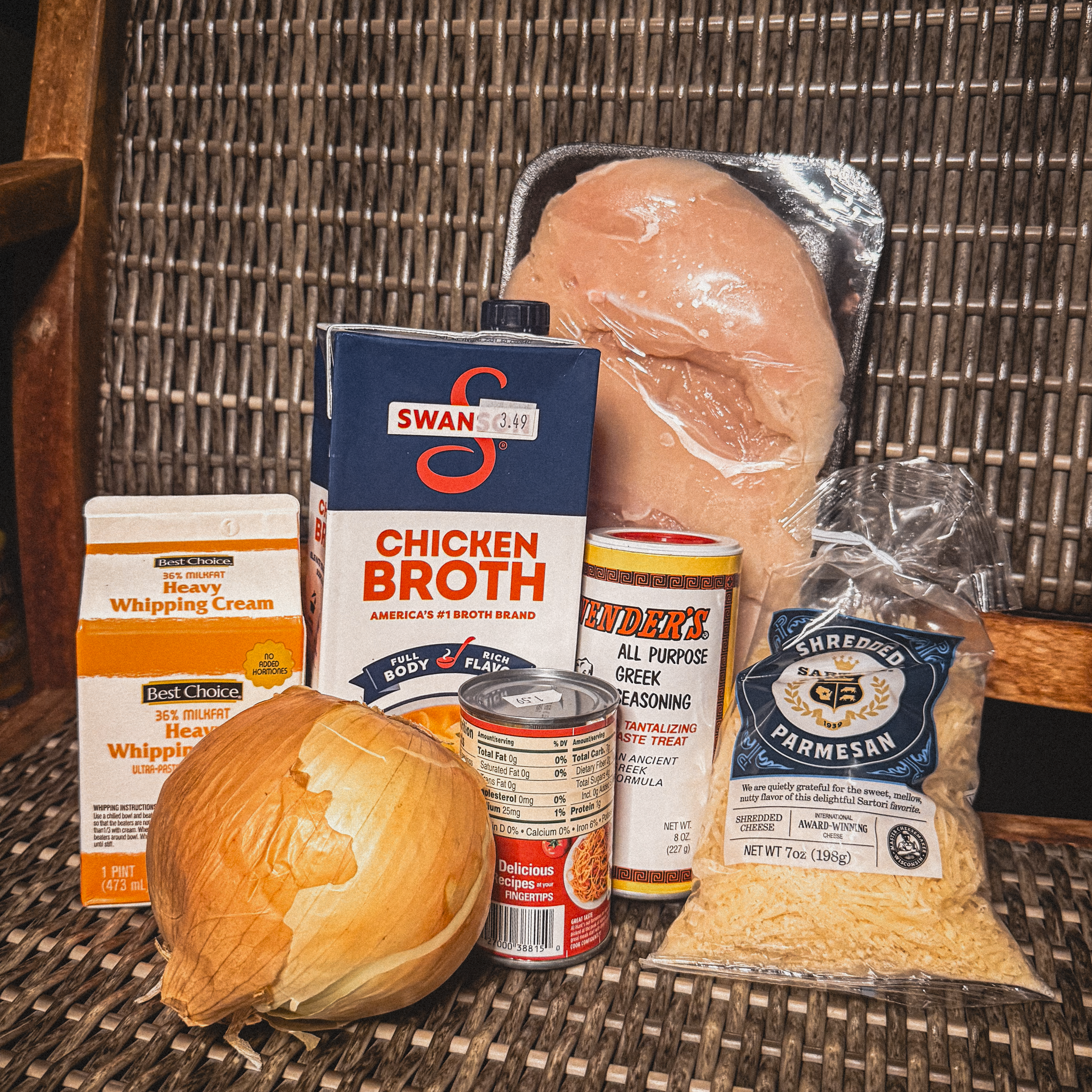
You’ll Need
- 4 large boneless, skinless chicken breasts
- Salt and pepper
- ½ cup all-purpose flour
- 4 Tbsp butter, divided
- 2 Tbsp cooking oil
- ½ small yellow onion, finely diced
- 4 cloves garlic, minced
- ¼ tsp crushed red pepper flakes
- 2 Tbsp tomato paste
- 2½ cups chicken broth, divided
- 1 Tbsp lemon juice
- 1 tsp Greek seasoning
- 1 cup heavy cream
- ½ cup grated parmesan cheese
- Parsley and additional parmesan for serving
- Mashed potatoes, pasta, or rice, for serving
Let’s Cook
- Slice each chicken breast horizontally to make thinner cutlets. Season with salt and pepper, then lightly coat each piece in flour.
- Heat 2 tablespoons butter and the oil in a large skillet over medium heat. Brown the chicken on both sides until golden. Work in batches if necessary, then move the chicken to a plate.
- Lower the heat and add the remaining butter and diced onion. Cook until the onion begins to soften.
- Add the garlic, red pepper flakes, and tomato paste. Stir for about a minute.
- Pour in ½ cup chicken broth and the lemon juice, scraping the browned bits from the bottom of the skillet. Let it simmer for a couple of minutes.
- Add the remaining 2 cups chicken broth and Greek seasoning. Bring to a gentle simmer.
- Return the chicken to the skillet and simmer until the chicken reaches 165°F and the sauce begins to thicken.
- Lower the heat and stir in the heavy cream and parmesan. Let everything gently simmer for another few minutes until the sauce is creamy and coats the chicken.
- Top with parsley and extra parmesan. Serve with mashed potatoes, pasta, or rice, and whether anybody actually proposes afterward is between y’all.
Fresh Chicken at the Counter
Our fresh chicken case has more than one way into this recipe:
- Boneless, skinless breasts — what the recipe calls for. Ask and we will split them into cutlets.
- Thighs — richer and very hard to overcook. Ask for boneless and brown them whole, no splitting needed.
- Leg quarters and drumsticks — for roasting nights, not cream sauce nights.
- Smoked chicken — already cooked, for the nights you do not want to cook at all.
- Freezer specials — leg quarters come in both bundles, if you are stocking up.
Tips from Behind the Counter
Shake off the extra flour. A thin, even coat browns. A thick, pasty one turns gummy in the sauce.
Don’t move the cutlets for the first two minutes. They will stick at first and release on their own once a crust forms. Pulling early tears the coating.
Cook the tomato paste until it darkens. The recipe gives it a minute. Watch it go from bright red to brick. That is the raw taste cooking off.
Use oil-packed sun-dried tomatoes and a spoonful of the oil. The oil has absorbed tomato flavor and it is free.
Go easy on the salt. Greek seasoning blends like Cavender’s carry plenty of salt already. Season the cutlets lightly and taste the sauce before adding more.
Thin with broth, not cream. If the sauce gets too thick while it sits, a splash of broth loosens it without dulling the flavor.
Ways to Change It Up
- Use boneless thighs and skip the splitting.
- Stir in a couple handfuls of baby spinach with the cream.
- Swap Greek seasoning for Italian seasoning and a pinch of smoked paprika.
- Add sliced mushrooms with the onion.
- Serve it over penne and toss everything together in the skillet.
One Stop for Sunday Dinner in Hattiesburg
We are closed on Sundays. Pick up the chicken breasts on Saturday. They will keep in the fridge overnight, and if you ask, we will split them into cutlets before they go in the bag.
Family owned and operated in Hattiesburg since 1991. Hours: Monday–Tuesday and Thursday–Saturday, 9:30 a.m. to 5:30 p.m. Closed Wednesday and Sunday. Phone: 601-261-2765. Address: 1910 Broadway Drive, Hattiesburg, MS 39401. Smoked sausage ships nationwide; also on shelves across Mississippi and the Gulf South.
Want the specials first? Text Butcher to 601-281-6633 to join our VIP text program.