Slow-Cooker Pork Carnitas Quesadillas with Mexican Street Corn
September 5, 2026
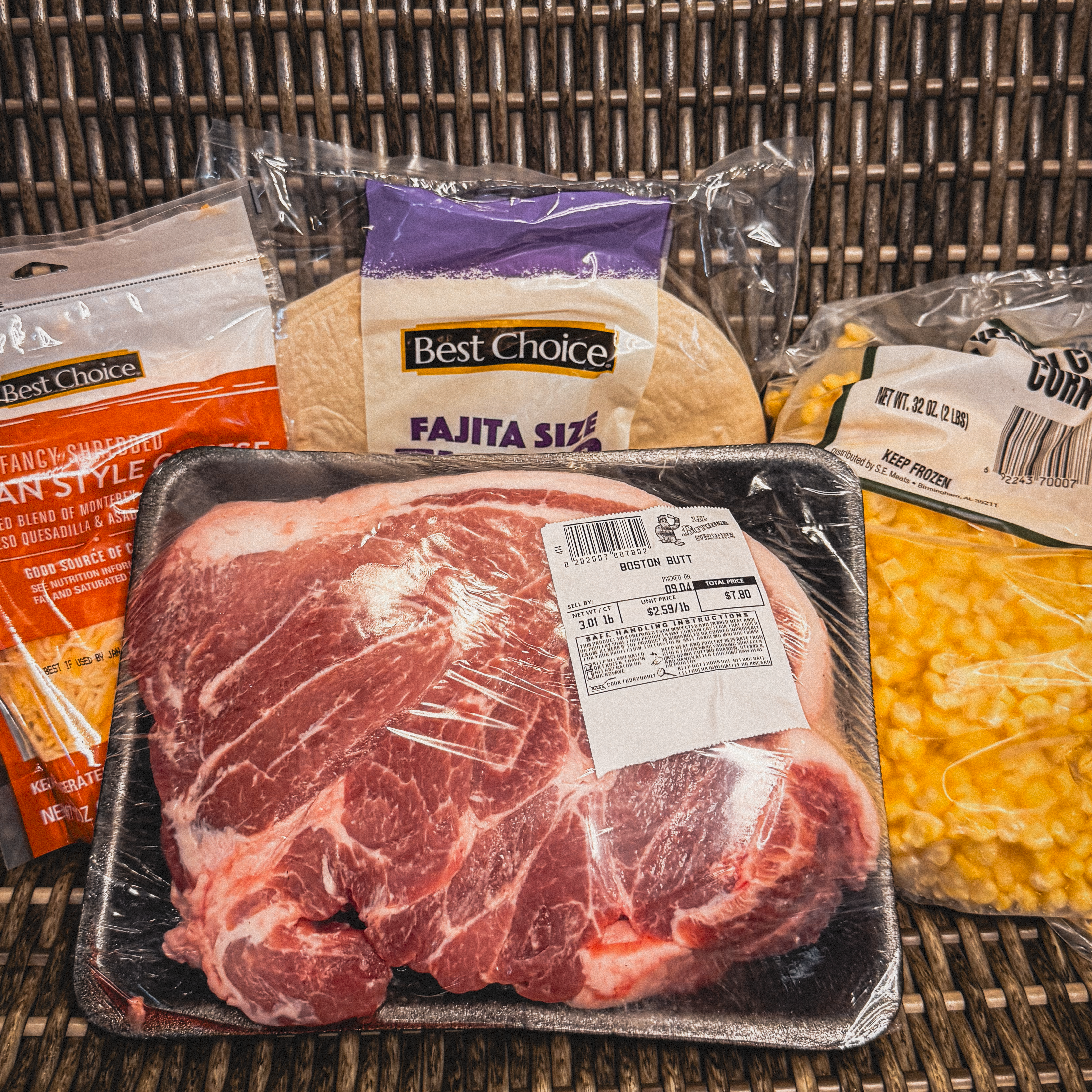
The slow cooker handled the meat. Cheese and tortillas handled the rest. Saturday dinner understood the assignment.
Saturday is the one day of the week where an eight-hour cook is easier than a thirty-minute one. Nobody’s watching the clock at 4 p.m. You put a boston butt in the slow cooker in the morning, you leave, you come back, and the hard part is finished.
One roast makes enough carnitas for quesadillas on Saturday and tacos, nachos or a rice bowl on Sunday. Which is good, because we’re closed Sunday and you were not going to be shopping anyway.
Two things about this one. The first is what you’re actually buying. The second is the step at the end that most slow-cooker carnitas recipes skip, and shouldn’t.
Pork Butt Is a Shoulder, and It’s Not the Rear End
Let’s clear this up, because it confuses people at the counter every week.
Pork butt is not from the back of the pig. It’s from the front — the upper part of the shoulder, above the shoulder blade. The name is a leftover from colonial New England, where butchers packed cheap shoulder cuts into barrels called butts for shipping. The barrel gave the cut its name, and 250 years later people are still standing in front of a case wondering why a shoulder is called a butt.
You’ll also see it labeled Boston butt, which is the same thing.
Here’s the part that actually affects your dinner. The pork shoulder is two different cuts, and only one of them is right for this.
Boston butt is the upper section. It’s rectangular, thick, heavily marbled, and it has a fat cap on one side and a blade bone running through the middle. This is the carnitas cut. All that intramuscular fat and collagen melts over eight hours and turns into meat that shreds with a fork and stays moist for two days of leftovers.
Picnic shoulder is the lower section, running down toward the front leg. It’s more triangular, it’s usually sold with the skin on, and it has more sinew, more surface fat and less marbling. It’s cheaper. It makes good pulled pork, but you’ll spend fifteen extra minutes picking through it after it’s cooked, and the yield is lower once you’ve thrown away the gristle.
There should be a boston butt in the case by the pork steaks, but just ask if you don’t see it!
Something to note:
Don’t trim the fat cap. People trim it because it looks like waste. It’s the opposite: it renders down through the roast over eight hours and bastes the whole thing from the top. You can skim what’s left off the liquid at the end in about ten seconds.
A Slow Cooker Cannot Brown Anything
This is the reason so many slow-cooker carnitas come out gray and disappointing, and it isn’t the recipe’s fault. It’s physics.
Browning (the Maillard reaction, the thing that makes meat taste roasted) needs a dry surface at roughly 300°F or higher. A slow cooker is a sealed, humid box. Its liquid can’t exceed 212°F, steam condenses on the lid and drips back down, and the meat sits in a moist environment the entire time. There is no point in those eight hours at which any part of that pork is dry enough or hot enough to brown. It can’t happen.
What the slow cooker is extraordinarily good at is the other half of the job: holding meat at 190–205°F for hours so collagen dissolves into gelatin. That’s why the pork shreds with two forks instead of resisting. That is a genuinely hard thing to do in an oven without drying out the outside, and a slow cooker does it perfectly.
So the slow cooker does the tenderizing, and something else has to do the browning. That’s the broiler step.
Real carnitas are traditionally confited in lard and then crisped. The name means “little meats,” and the crispy, lacquered edges are the entire identity of the dish. Shredded pork straight out of a slow cooker is pulled pork. Shredded pork spread thin on a sheet pan, drizzled with a few spoonfuls of its own cooking liquid, and run under the broiler for five minutes is carnitas.
Spread it in a thin layer. Piled-up pork steams itself and you’re back where you started. You want the meat in a single layer with space between the shreds so the surface dries out and the edges catch. Five minutes, watch it, pull it when the tips are dark.
On temperature: the USDA safe temperature chart puts whole-muscle pork at 145°F with a three-minute rest, and that’s the right target for a chop or a loin. A shoulder is the exception. It hits 145°F after about three hours and it will still be tough as a boot, because the collagen hasn’t gone anywhere yet. Keep going to 195–205°F. Safety was settled hours earlier; you’re cooking for texture now.
Slow-Cooker Pork Carnitas Quesadillas with Mexican Street Corn
Prep time: 15 minutes
Cook time: 8 hours on low or 4–5 hours on high, plus 15 minutes to finish
Serves: 6–8
You’ll Need
For the Carnitas
- 1 Lil Butcher Shoppe Pork Shoulder or Pork Butt, approximately 2½–3 lbs.
- 1 cup chicken broth
- Juice of 1 lime
- 1 teaspoon cumin
- 1 teaspoon chili powder
- 1 teaspoon garlic powder
- 1 teaspoon paprika
- ½ teaspoon onion powder
- Salt and black pepper
For the Quesadillas
- 8 large flour tortillas
- 2 cups shredded Mexican-style cheese
- Salsa for serving
- Sour cream, optional
For the Corn
- 1 bag frozen corn
- 2 tablespoons mayonnaise
- Juice of ½ lime
- ¼ cup grated Parmesan or crumbled queso fresco
- ½ teaspoon chili powder
- Salt
Let’s Cook
Place the pork in the slow cooker.
Season with cumin, chili powder, garlic powder, paprika, onion powder, salt and black pepper.
Pour the chicken broth and lime juice around the pork.
Cover and cook on low for approximately eight hours or on high for four to five hours, until the meat shreds easily.
Remove the pork and shred it with two forks.
For extra carnitas-style crispy edges, spread some of the shredded pork onto a baking sheet and place it under the broiler for a few minutes.
To make the quesadillas, place shredded cheese and carnitas on one half of each tortilla.
Fold the tortillas over and cook in a skillet over medium heat until golden on both sides and the cheese is melted.
Cut into wedges.
For the corn, cook the frozen corn according to the package directions.
Stir in the mayonnaise, lime juice, Parmesan or queso fresco, chili powder and a pinch of salt.
Serve the crispy carnitas quesadillas with the street corn, salsa and sour cream.
The slow cooker handled the meat. Cheese and tortillas handled the rest. Saturday dinner understood the assignment.
What Else Is at the Pork Counter
Fresh local pork, cut here. Boston butt, pork roasts, ribs, chops at any thickness you name, and our own stuffed pork chops from the homemade case. Tell us what you’re making and we’ll point you at the right end of the animal.
If you want the heat to come from the meat instead of the seasoning, the freezer has chorizo made here. The smoked sausage side has sweet fire and jalapeño and cheddar among the 12 flavors. Full lineup on the Butcher Shoppe page.
Tips from Behind the Counter
Don’t add more liquid than the recipe says. One cup is enough. The shoulder releases a lot of its own, and a swimming roast is a boiled roast. You want the bottom third submerged, not the whole thing.
195–205°F, not 145°F. Pork is safe at 145°F per the USDA chart, but a shoulder isn’t done until the collagen breaks down. Cook to texture, not to the safety minimum.
The broiler step is the recipe, not a bonus. A slow cooker physically cannot brown meat. Five minutes under the broiler in a thin layer is what turns pulled pork into carnitas.
Spoon cooking liquid over the pork before it goes under the broiler. Two or three tablespoons. It carries fat and seasoning, and it’s what lets the edges lacquer instead of just drying.
Build the quesadillas on one half and fold. A folded tortilla is easier to flip than two stacked ones and the cheese doesn’t escape out the side.
Ways to Change It Up
- Skip the tortillas and put the carnitas over rice with the street corn stirred in.
- Add a can of drained diced green chiles to the slow cooker with the broth.
- Swap the flour tortillas for corn tortillas and make street tacos with onion and cilantro.
- Use the leftovers for carnitas nachos on Sunday. Broil the pork a second time; it holds up.
- Put a fried egg on the leftover carnitas Monday morning and call it breakfast.
One Stop for Saturday Dinner in Hattiesburg
We’re closed Sunday, so if you want leftovers for Sunday too, buy the bigger butt on Saturday.
Family owned and operated in Hattiesburg since 1991. Hours: Monday–Tuesday and Thursday–Saturday, 9:30 a.m. to 5:30 p.m. Closed Wednesday and Sunday. Phone: 601-261-2765. Address: 1910 Broadway Drive, Hattiesburg, MS 39401. Smoked sausage ships nationwide; also on shelves across Mississippi and the Gulf South.
Want the week’s specials before they’re gone? Text Butcher to 601-281-6633.